






































































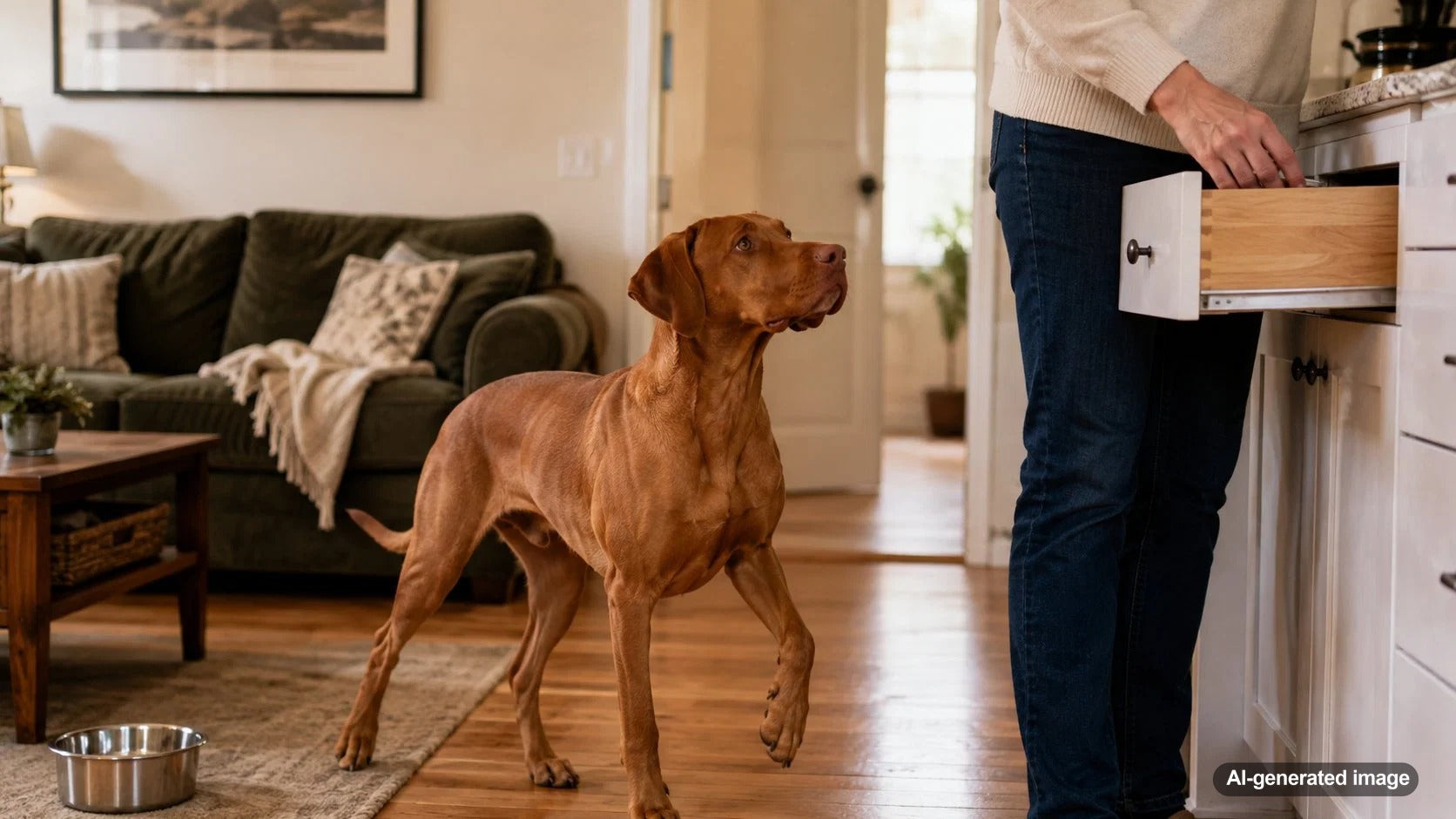
You open one perfectly ordinary kitchen drawer and suddenly your dog appears beside you like they have been summoned. Maybe their ears perk up from another room, their paws start tapping across the floor, or they plant themselves directly beneath your hand with the confidence of someone who knows exactly what happens next. Your dog is not reading your mind. They have probably learned that the sound, location, movement, or routine surrounding that drawer predicts something worth investigating, especially if treats have appeared from it before.
Dogs are remarkably good at noticing patterns in everyday life. A drawer sliding open, a treat bag crinkling, the refrigerator door moving, or even the way you walk toward a cabinet can become meaningful when it repeatedly happens before food, play, a walk, or another rewarding experience.
Your Dog Has Learned the Kitchen Drawer Predicts Something Good
Dogs do not need a formal training session to learn associations. They are learning from repeated patterns all day long. If you open the same drawer before handing over a snack often enough, the drawer itself can start predicting the snack.
Think about the entire sequence from your dog's perspective. You walk into the kitchen. You stop beside one cabinet. Your hand reaches down. The drawer makes its familiar sliding or clicking sound. Then a treat appears. After enough repetitions, your dog does not need to wait for the treat bag to emerge. The earlier clues in the sequence can be enough to send them running.
This is also why some dogs react to remarkably specific household sounds. They may ignore five other drawers but sprint toward the kitchen when the treat drawer opens. They have learned which details matter.
Dogs Notice More Than the Sound
The drawer noise may be the obvious trigger, but your dog could be responding to several clues at once. Your footsteps toward the kitchen, the time of day, your posture, the cabinet you stand beside, or the routine that usually happens afterward may all contribute.
For example, a dog who receives a bedtime treat every night might start appearing before the drawer even opens once they see you following the familiar evening routine. Another dog may react from across the house to one distinctive wooden scrape because that noise reliably precedes a favorite reward.
This kind of pattern recognition explains plenty of other dog-parent mysteries too, including the dog who magically appears when a cheese wrapper opens or heads toward the door when you put on a particular pair of shoes.
Why Some Dogs React More Dramatically Than Others
Not every dog will launch themselves toward the kitchen with equal enthusiasm. Food motivation, personality, past experiences, age, and household routines can all influence the response.
Puppies may quickly investigate because everything is still becoming part of their mental map of household life. Highly food-motivated dogs may notice food-related patterns after relatively few repetitions. Senior dogs may rely heavily on established routines they have followed for years, although changes in hearing, mobility, appetite, or cognition can affect how they respond.
If your dog's interest in food suddenly becomes dramatically stronger or weaker, especially alongside weight changes, vomiting, diarrhea, excessive thirst, unusual drooling, pain, or other behavior changes, contact your veterinarian. A familiar kitchen habit is one thing; a major unexplained change deserves professional attention.
Did You Accidentally Train Your Dog to Come Running?
Probably, and that is not necessarily a problem. Every time the drawer opens and your dog receives something valuable, the connection can become stronger. Even occasional rewards can keep the habit interesting because your dog may decide that checking the kitchen is always worth the trip.
Dog parents sometimes reinforce the routine without realizing it. Your dog arrives, gives you an irresistible stare, and you hand over one little treat because they are already there. From your dog's perspective, rushing into the kitchen worked beautifully.
If you enjoy the ritual and your dog waits politely, there may be no reason to change it. The goal is simply to make sure excitement around the drawer does not turn into jumping, barking, crowding, counter surfing, or grabbing dropped food.
Turn the Treat Drawer Into a Useful Training Opportunity
Instead of trying to eliminate your dog's excitement, you can give them a more useful behavior to perform. Before opening the drawer, ask for something simple that your dog already understands, such as sitting, waiting, or going to a mat. Reward the calm behavior rather than the frantic arrival.
Small rewards make repetition easier. Bite-sized options such as Love Nuggets can fit naturally into short training moments when you want to reinforce polite kitchen behavior without turning every drawer opening into a giant snack event.
What If You Do Not Want Your Dog Running to the Kitchen?
If kitchen crowding is becoming inconvenient, start by reducing the payoff for rushing toward the drawer. Avoid casually handing out food simply because your dog appeared. Instead, teach an alternate routine such as going to a nearby bed or mat while you prepare food.
Practice when there is very little excitement. Open the drawer briefly, cue your dog's preferred waiting spot, and reward them there. Gradually practice with more realistic kitchen activity. Consistency matters because a dog who sometimes gets rewarded for hovering under the drawer and sometimes gets rewarded for staying on a mat receives mixed information.
Management matters too. Keep foods that are unsafe for dogs securely stored, and be especially careful with medications, chocolate, foods containing xylitol, and other potentially dangerous items. If your dog grabs something that may be toxic, contact your veterinarian or an appropriate pet poison professional right away.
Give That Food Motivation Somewhere Productive to Go
A dog who becomes intensely interested whenever food appears may be telling you something useful: food is a powerful motivator for them. You can channel some of that enthusiasm into training and enrichment instead of handing over instant snacks every time they investigate the kitchen.
For dogs who enjoy working on a food reward, The Pupsicle can turn treat time into a longer-lasting interactive activity. Rather than offering several quick treats from the drawer, an enrichment routine can give your dog something purposeful to lick and engage with while you cook, answer emails, or handle another part of your day. Always choose treats and enrichment that suit your dog's size, eating habits, and individual needs, and supervise appropriately.
Dog Parent FAQs
Can dogs really recognize the sound of one specific drawer?
Yes. Dogs can learn that specific sounds and environmental cues predict particular outcomes. If one drawer repeatedly produces treats while another holds dish towels, your dog may learn that the difference matters.
Why does my dog come running even when I am not getting a treat?
Your dog cannot know what is inside your plan for that particular drawer opening. If the sound has predicted treats many times before, checking the kitchen may still feel worthwhile even when nothing happens this time.
Should I give my dog a treat every time they come to the drawer?
No. If you do not want rushing or begging to become stronger, reward a behavior you actually want, such as sitting calmly or waiting on a mat.
Why does my dog react to wrappers, containers, and the refrigerator too?
The same learning process can happen with many household cues. Sounds, movements, locations, and daily routines can all become signals when they repeatedly happen before something your dog enjoys.
The Bottom Line
That dramatic sprint to the kitchen is usually less mysterious than it looks. Your dog has been paying attention, and a completely ordinary drawer may have become one of the most meaningful sounds in the house because of what has happened after it in the past.
You can enjoy the funny ritual, use it as a chance to practice calm behavior, or reshape the routine if kitchen excitement is getting out of hand. Either way, the next time you open that drawer and hear paws racing toward you, remember: to you it is storage. To your dog, it might sound a lot like opportunity.


