






































































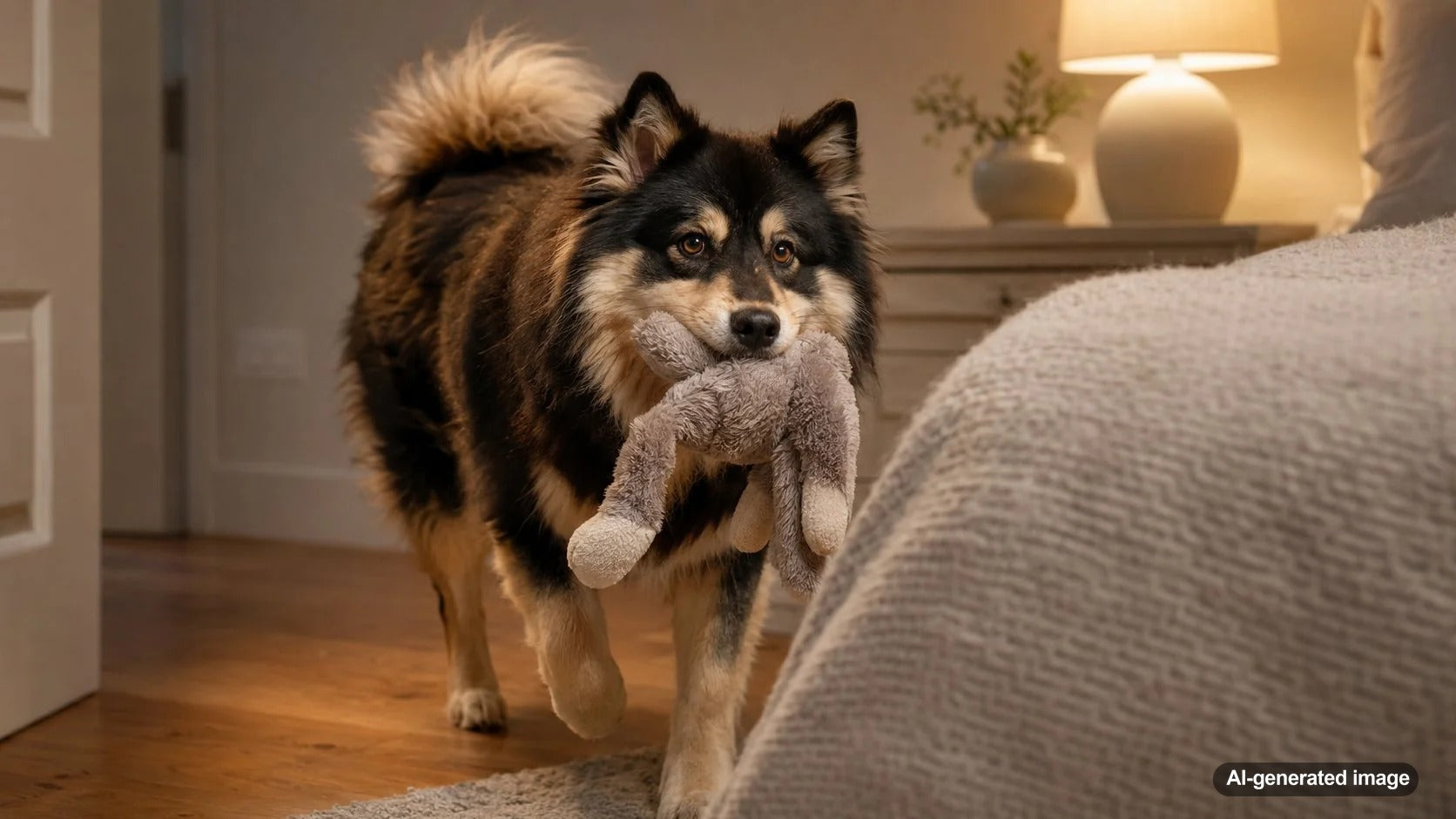
You have turned off the lights, pulled back the covers, and started winding down when your dog suddenly appears with a favorite toy. That bedtime delivery is usually not random. Your dog may be asking for connection, inviting one final round of play, following a familiar routine, or carrying something comforting into the sleeping area.
The meaning depends on what happens next. A loose, wiggly dog who drops the toy at your feet probably wants interaction, while a dog who quietly carries it to bed and curls up beside it may be using the toy as a comfort object.
Why Your Dog Brings You a Toy Right Before Bed
Dogs use objects as part of their communication. Since they cannot say, "Before we sleep, can we do something together?" they may present the clearest invitation they have: a ball, plush toy, rope, or chew.
Bedtime also creates a predictable transition. The household gets quieter, people move toward the bedroom, and access to attention is about to change. Your dog may recognize those cues and try to fit one more rewarding activity into the evening.
They Want One Last Moment of Connection
For many dogs, bringing a toy is a social gesture. The toy creates an opportunity for you to look at them, speak to them, touch them, or play. Even if your dog does not release it, the presentation itself may be the point.
Watch the body language. Playful invitations commonly include a relaxed mouth, wagging body, play bow, bouncing movement, or repeated approaches. A dog who keeps the toy while leaning against you may prefer shared attention over an actual game of fetch.
The Toy May Be Part of Their Settling Routine
Some dogs carry a particular toy the way a child might take a favorite comfort item to bed. Familiar scent, texture, and the act of holding or gently mouthing it may help signal that active time is ending.
This can be especially noticeable in puppies learning a household schedule, recently adopted dogs adjusting to a new home, or dogs who prefer predictable routines. Seniors may also become more attached to familiar patterns. Letting a dog keep a safe, intact toy nearby can be fine if the dog does not destroy or swallow pieces while unsupervised.
You May Have Accidentally Trained the Ritual
Dogs are excellent at noticing what works. If bringing a toy once led to a lively game, praise, or an invitation onto the bed, your dog may repeat the behavior. Even laughing, chasing them down the hallway, or negotiating for the toy can reinforce the routine.
This does not mean you have done anything wrong. It simply means the behavior has a history of paying off. If you enjoy the ritual, keep it. If it regularly delays sleep, give it a clearer beginning and ending.
They Still Have Energy to Use
A dog who spent much of the evening resting may become active when everyone else is ready for bed. Toy delivery can be a sign that the day's physical exercise, sniffing, training, or mental enrichment did not fully meet that dog's needs.
Puppies and adolescent dogs often need help switching from excitement to rest. A wild game of fetch immediately before bed can make some dogs more alert, so try lower-key enrichment instead. A short sniff walk, a few easy cues, or supervised licking can provide engagement without turning the bedroom into a racetrack.
For a calm pre-bed activity, The Pupsicle can offer longer-lasting treat enrichment. Use an appropriately sized toy, account for treats in your dog's daily food intake, and supervise based on your dog's chewing habits.
How to Respond Without Creating Bedtime Chaos
- Read the invitation: Notice whether your dog wants to fetch, tug, cuddle, chew, or simply carry the toy.
- Keep play brief: If you choose to play, use a predictable two- or three-minute session.
- Add a finish cue: Say a consistent phrase such as "all done," then put active toys away.
- Shift into calm: Follow play with a potty break, dim lights, quiet petting, or a settling activity.
- Reward relaxation: Calmly praise your dog for lying on their bed rather than repeatedly restarting the game.
If your dog enjoys licking before settling, a FlipMat can turn a small portion of dog-safe food into a slower, quieter activity. Introduce any new enrichment while you are present, and remove it if your dog starts tearing, swallowing, or guarding it.
When the Behavior Deserves a Closer Look
Occasional toy delivery is usually harmless. Contact your veterinarian if the behavior begins suddenly alongside pacing, panting, nighttime restlessness, excessive drooling, appetite changes, limping, confusion, or signs of pain. A sudden change in a senior dog's sleep or nighttime behavior also deserves professional guidance.
If your dog becomes stiff, growls, snaps, or guards the toy, do not forcibly take it away. Trade from a safe distance when possible and ask a qualified reward-based trainer or veterinary behavior professional for help. Resource guarding requires a thoughtful plan, not punishment.
Dog Parent FAQs
Is bringing me a toy before bed a sign of affection?
It can be. Many dogs use toys to start friendly interaction or share something they value, although the same behavior can also be a request for play or part of a learned routine.
Why does my dog bring a toy but refuse to give it to me?
Your dog may want you to notice, chase, or admire the toy rather than throw it. Avoid grabbing it, and observe whether your dog prefers gentle attention, a trade, or a different style of play.
Should my dog sleep with a toy?
That depends on the dog and the toy. An intact, appropriately sized toy may be suitable for a gentle dog, but destructive chewers and dogs who swallow pieces need closer supervision and a safer bedtime setup.
The Bottom Line
Your dog's bedtime toy delivery is often a small ritual built from connection, comfort, habit, and leftover enthusiasm. Pay attention to the toy, your dog's body language, and what usually happens afterward. With a brief response and a consistent wind-down routine, you can honor the invitation while still making it clear that nighttime is for settling.


