






































































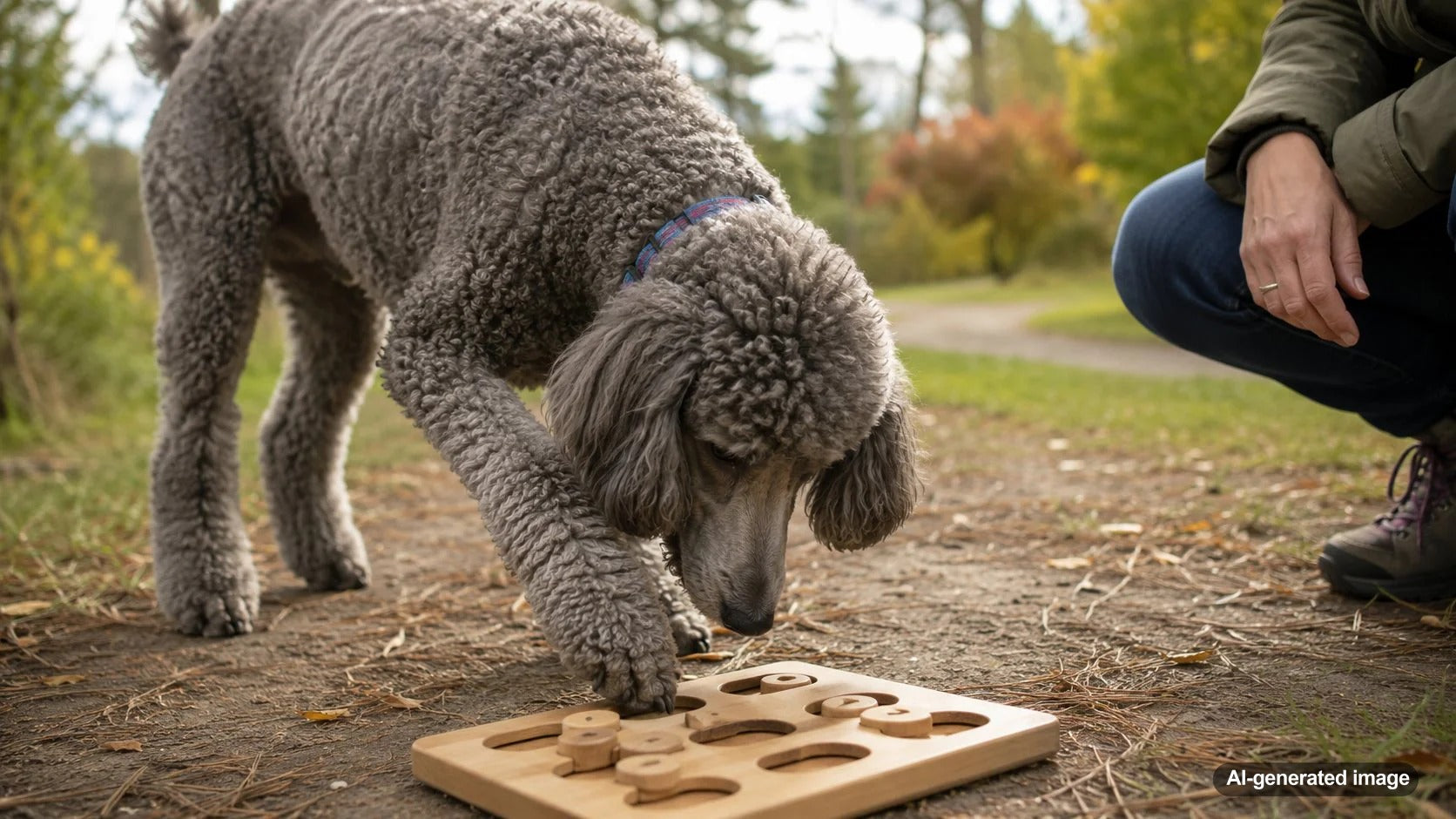
Poodles often learn so quickly that repeating the same basic cue can become less like practice and more like waiting through a commercial break. Standard, Miniature, and Toy Poodles tend to be observant, energetic problem-solvers that enjoy figuring out how their actions produce a reward. When training includes choices, movement, scent, and small challenges, many Poodles become more focused, enthusiastic, and eager to keep playing.
The goal is not to make every lesson difficult. It is to create just enough mystery that your Poodle has to think instead of simply running through a memorized routine.
Quick answer: Poodles thrive when training feels like a puzzle because they tend to enjoy learning patterns, testing solutions, and working closely with their people. Short, reward-based sessions that gradually introduce new challenges can satisfy their need for mental stimulation while building useful everyday skills.
Poodles Were Built to Think and Work
Poodles are sometimes viewed mainly as elegant companion dogs, but their history includes retrieving work that required athleticism, responsiveness, persistence, and cooperation with a handler. Those qualities still show up in modern Poodles. A dog that watches where you place a treat, anticipates your next cue, or invents a shortcut through an exercise is not necessarily being stubborn. Your Poodle may be studying the problem.
This sharp awareness can make training wonderfully rewarding, but it also means mindless repetition may lose its appeal. A bored Poodle might begin offering random tricks, barking for the reward, wandering away, or turning the training session into a game of keep-away.
What Puzzle-Style Training Looks Like
Puzzle-style training asks your dog to make a decision. Instead of giving a cue and immediately showing the answer, you set up a manageable challenge and reward your Poodle for moving toward the solution.
For example, place two open boxes on the floor and hide a treat in one. Let your dog investigate and reward the successful search. Later, add a third box, partially close the flaps, or ask for a sit before releasing your dog to search. One simple activity can practice impulse control, scent work, patience, and problem-solving.
You can also turn familiar cues into mini challenges:
- Ask for a touch cue from different positions instead of always holding out the same hand.
- Place a mat several feet away and reward your dog for finding and settling on it.
- Hide a favorite toy and teach a cue such as "find it."
- Practice retrieving named objects, starting with two toys that look very different.
- Scatter part of a meal in a safe room and let your dog search instead of eating from a bowl.
Use Rewards Without Turning Training Into a Treat Frenzy
Fast learners can become fast treat grabbers. Use small rewards so you can repeat an exercise without overfeeding, and deliver each reward calmly. Love Nuggets are bite-sized training treats that can fit naturally into short puzzle sessions and repeated skill practice.
Keep the reward hidden until your dog completes the behavior. If your Poodle can see the treat the entire time, the exercise may become more about following food than understanding the cue. Once a skill is familiar, mix food rewards with praise, play, access to a toy, or permission to sniff.
Helpful tip: End the session while your Poodle is still interested. Three focused minutes can be more productive than 15 minutes that end in barking, frustration, or wandering away.
Match the Challenge to Your Poodle
A good puzzle is challenging but solvable. If your dog gives up, scratches frantically, whines, or starts biting at the equipment, make the next attempt easier. Frustration is not proof that the activity is working.
Poodle puppies
Puppies usually do best with very short sessions and obvious solutions. Let them watch you place a treat under a lightweight cup, reward simple exploration, and avoid expecting sustained concentration. Puppies also need plenty of rest, so stop when their movements become frantic or unfocused.
Adult Poodles
Healthy adults may enjoy layered challenges that combine movement and thought. You might ask for a short sequence such as touching a target, walking around a cone, and then searching for a hidden reward. Change only one part at a time so your dog understands the game.
Senior Poodles
Senior dogs can still enjoy learning, but the activity may need to be slower and physically easier. Use non-slip flooring, keep searches close to the ground, and avoid repeated jumping or tight turns. Sudden confusion, major behavior changes, reluctance to move, or a noticeable loss of interest should be discussed with your veterinarian.
Turn Meals and Play Into Training Opportunities
Not every brain game needs to look like a formal obedience session. A portion of your Poodle's regular meal can become a rolling, sniffing, or problem-solving activity. The Walkabout is a rolling slow-feeder puzzle ball with an adjustable opening that can turn kibble or treats into a more active search.
Start on an open, uncluttered floor and set the opening wide enough that food comes out easily. Once your dog understands that movement releases the reward, gradually increase the difficulty. Supervise the first sessions, choose food that fits the opening, and count puzzle food as part of the day's normal intake.
Common Mistakes That Make Smart Dogs Check Out
Watch for these training traps:
Repeating a cue over and over: Saying "sit" five times teaches your dog that the first four requests do not matter. Give the cue once, pause, and make the setup easier if needed.
Increasing difficulty too quickly: Change one variable at a time, such as distance, duration, distractions, or the number of puzzle steps.
Using only physical exercise: A long walk may not fully satisfy a dog that also wants to sniff, search, and solve.
Correcting experimentation: During a new puzzle, allow safe attempts. Reward progress instead of punishing wrong guesses.
A Simple Five-Minute Puzzle Routine
Begin with one minute of an easy cue your dog already knows. Follow with two minutes of a new challenge, such as finding a hidden treat beneath one of three cups. Spend the fourth minute practicing a useful behavior like going to a mat or dropping a toy. Finish with an easy success and a calm reward.
Rotate the activity every few days rather than constantly buying new equipment. Cups, cardboard boxes, towels, toys, and pieces of kibble can all create fresh challenges when used safely and under supervision. Remove anything your dog begins shredding or trying to swallow.
Dog Parent FAQs
Do Poodles need puzzle toys every day?
Not necessarily. Many Poodles benefit from some form of daily mental activity, but that can include scent walks, trick training, hide-and-seek, food puzzles, retrieving, or learning household routines.
How long should a Poodle training session last?
Many dogs do well with several short sessions of about three to five minutes. Stop sooner if your dog becomes frustrated, distracted, or overly excited.
Can puzzle training reduce destructive behavior?
Appropriate enrichment may help meet a dog's need to explore and work, but destructive behavior can have several causes. Contact a veterinarian or qualified trainer if the behavior is sudden, severe, or connected to distress when your dog is alone.
What if my Poodle solves every puzzle immediately?
Add difficulty gradually by increasing distance, introducing a short wait, hiding the reward more carefully, or combining two familiar skills. Avoid making the puzzle so difficult that your dog stops enjoying it.
Keep the Cleverness Working for You
Poodles often shine when training becomes a conversation rather than a drill. Give your dog a clear goal, room to experiment, and a reward worth earning. With short sessions and gradually changing challenges, everyday training can become the kind of brain game your Poodle looks forward to solving with you.


