






































































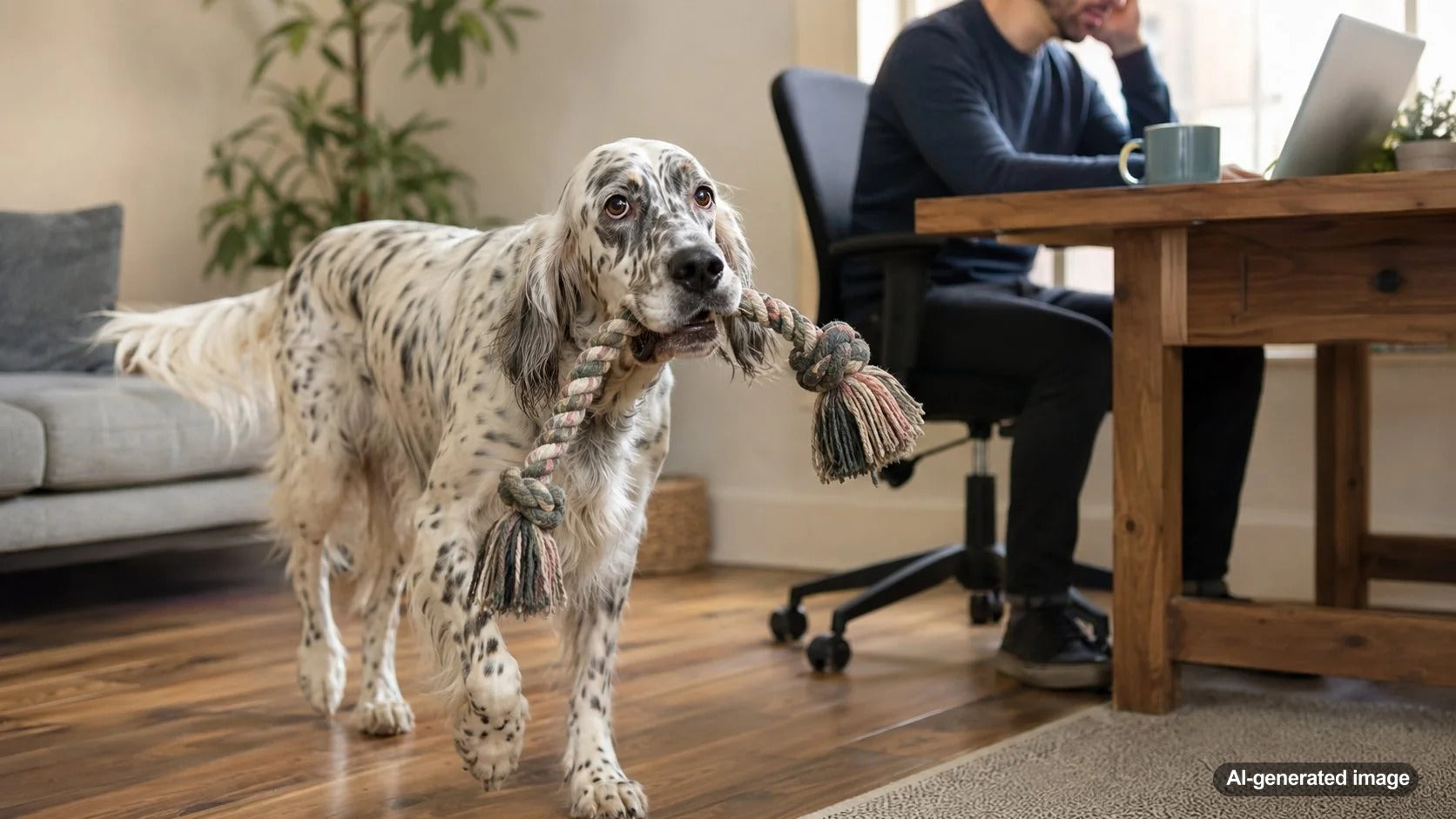
You are answering emails, folding laundry, or trying to finish dinner when a tennis ball lands at your feet. Your dog stares at you, nudges the toy closer, and seems completely unconcerned with your schedule. Dogs often bring toys to busy people because they want interaction, have learned that this tactic gets a response, or need an outlet for energy and excitement.
The delivery is rarely random. Your dog may be inviting you to play, checking whether you are available, sharing something valuable, or repeating a behavior that worked before. Understanding the message can help you respond without accidentally teaching your dog that every video call should include an urgent round of fetch.
Why Your Dog Chooses the Busiest Moment
Dogs are excellent observers of routines. They notice when your attention shifts to a laptop, phone, book, or household task. If those moments usually mean less interaction, your dog may try a familiar strategy for bringing your attention back.
Your response also matters. Looking down, laughing, touching the toy, or saying your dog's name can reward the delivery even if you never throw the toy. From your dog's perspective, interrupting you worked. Dogs repeat behaviors that produce useful or enjoyable outcomes.
Timing can also reflect your dog's daily rhythm rather than your workload. A dog who naps through the morning may naturally become playful during your afternoon meeting. Puppies and adolescent dogs often have shorter rest-and-activity cycles, while some senior dogs prefer several brief interactions instead of one demanding play session.
What the Toy Delivery May Mean
An invitation to play
A loose body, wagging tail, play bow, and quick retreat after dropping the toy usually signal a friendly invitation. Some dogs place the toy in your lap. Others keep it in their mouth and expect you to chase them or start tugging.
A request for connection
Play is social for many dogs. Your dog may bring a favorite object because sharing an activity with you is more rewarding than playing alone. Retrievers and other dogs selected for carrying objects may do this frequently, but any breed or mix can develop the habit.
A learned attention strategy
If bringing a toy reliably earns eye contact, conversation, petting, or a toss, it becomes a powerful communication tool. This is not manipulation in a human sense. Your dog has simply learned a clear cause-and-effect pattern.
Extra physical or mental energy
A dog who has had a quiet day may seek action when you settle into a task. Look at the larger routine. Repeated pacing, barking, stealing objects, restless wandering, or difficulty settling alongside toy delivery may suggest that your dog needs more appropriate activity or mental enrichment.
Excitement that needs somewhere to go
Some dogs grab and carry toys when a person arrives home, visitors enter, or the household becomes lively. Holding an object may give that excitement a safe outlet. If your dog is wiggly but relaxed, this can be a perfectly normal greeting ritual.
How to Respond When You Cannot Play
You do not have to choose between ignoring your dog completely and abandoning your task. A brief, predictable response can acknowledge the request while maintaining a boundary.
- Acknowledge calmly: Say a consistent phrase such as "Not now" or "Later," then avoid repeatedly negotiating with your dog.
- Offer a clear cue: Ask for "place," "settle," or "bed" if your dog already understands it. Reward calm behavior after your dog settles.
- Schedule a short play break: Two to five focused minutes of tug, fetch, or training may be more satisfying than distracted interaction stretched across half an hour.
- Provide independent enrichment: Give your dog an activity that does not require you to keep throwing or tugging.
- Follow through later: If "later" always means never, your dog has little reason to trust the routine.
For dogs who enjoy working for food, a rolling puzzle such as the Walkabout can turn part of a measured meal into supervised independent activity. Adjust the opening for the kibble or treat size, introduce the toy when you have time to observe, and count the food toward your dog's daily intake.
Avoid Accidentally Rewarding Pushy Behavior
If you throw the toy after the fifth bark, paw, or lap-drop, your dog may learn that persistence is the winning strategy. Instead, wait for a brief moment of quiet or another behavior you want, such as sitting or lying down, before beginning play.
A simple routine can make the distinction clear: ask for a sit, say a play cue, enjoy a short game, then use an ending cue such as "all done." Put the toy away or provide a separate solo activity afterward. Consistent beginnings and endings help many dogs understand when interactive play is available.
Avoid scolding your dog merely for bringing a toy. The delivery itself is an appropriate form of communication. If you want less interruption, teach an alternative rather than punishing the request.
Make Busy-Time Enrichment Safer and Easier
Choose activities that match your dog's play style. A gentle small dog, a puppy exploring with needle-sharp teeth, and a large power chewer should not automatically receive the same toy. Inspect enrichment items regularly and remove anything that is cracked, torn, or small enough to swallow.
Food-filled toys and chews still require supervision, especially during their first uses. Introduce one while you are nearby instead of handing it over for the first time as you leave the house. The Pupsicle can provide licking-based engagement during a work block, but it should be correctly sized and used according to its directions. Adjust meal portions when adding treat-based enrichment.
When the Behavior Deserves a Closer Look
Frequent toy delivery is usually harmless, but context matters. Contact your veterinarian if the behavior appears suddenly alongside appetite changes, pain, limping, excessive drooling, confusion, sleep disruption, or another major physical or behavioral change.
A qualified trainer or veterinary behavior professional can help if your dog guards the toy, snaps when it is not thrown, cannot settle despite an appropriate routine, or becomes distressed whenever your attention shifts away. Do not forcibly remove a guarded object. Use distance and professional guidance to keep everyone safe.
Dog Parent FAQs
Is my dog giving me a gift?
Possibly, but it is safer to view the behavior as social sharing or a request for interaction. Dogs do not necessarily understand gifts the way people do.
Why does my dog bring a toy but refuse to drop it?
Your dog may want tug, chase, or attention rather than fetch. Teach "drop" through positive trades instead of chasing or prying the toy from your dog's mouth.
Should I always play when my dog brings me a toy?
No. It is healthy to provide regular play while also teaching your dog to wait and settle. Predictable play periods can make boundaries easier to understand.
Does bringing toys mean my dog is bored?
Sometimes, but not always. Consider the dog's full day and body language. A single cheerful invitation is different from persistent restlessness, destructive chewing, or an inability to relax.
The Bottom Line
When your dog delivers a toy during your busiest moment, the toy is often a conversation starter. Respond to the need behind it with planned play, calm boundaries, or suitable enrichment. With a repeatable routine, your dog can learn that connection is still coming, even when you cannot throw the ball right this second.


