






































































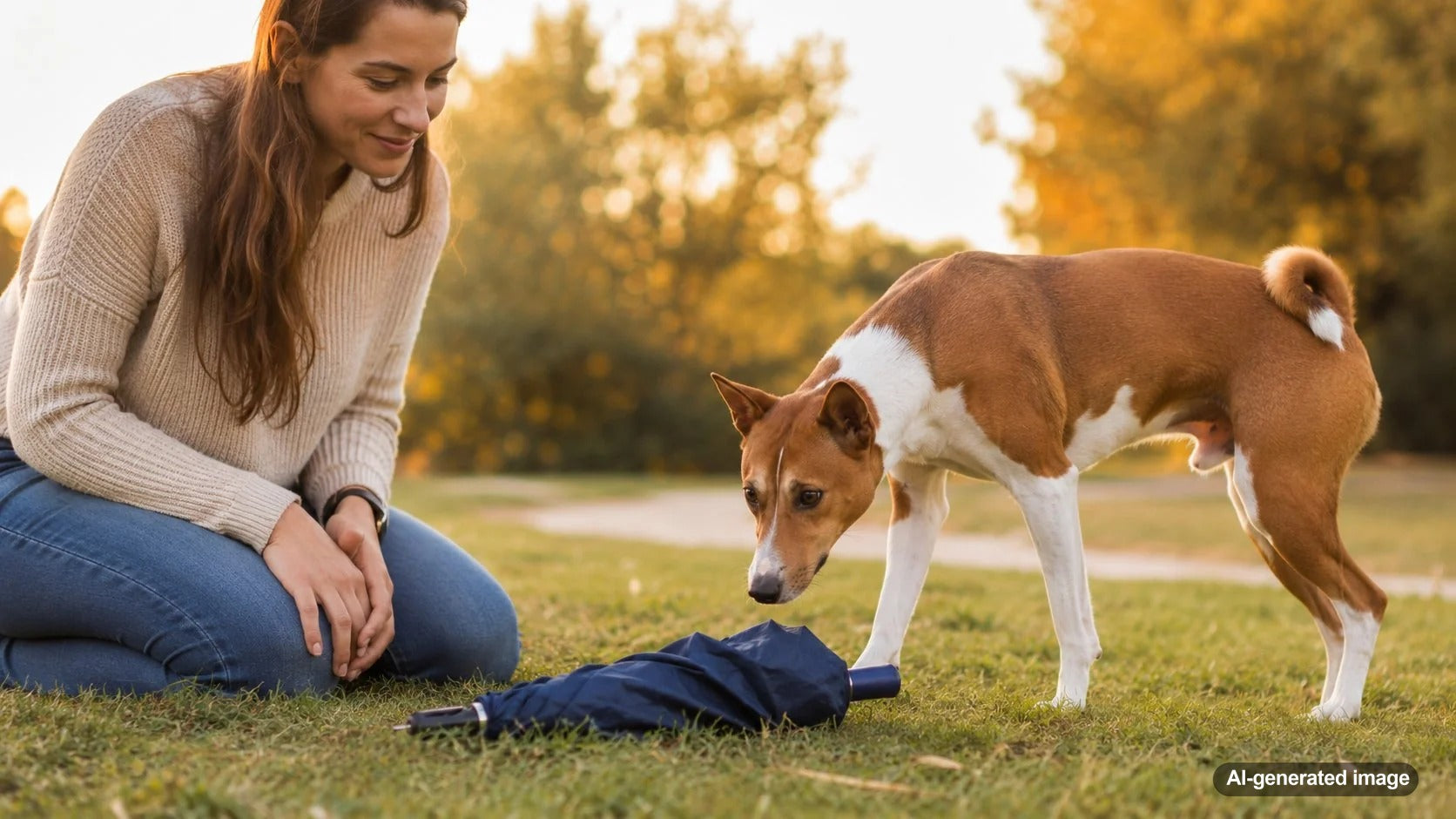
A cardboard box appears in the hallway and suddenly your normally confident dog is creeping past it like it might grow legs. A new trash can, folded stroller, holiday decoration, delivery package, or oddly shaped toy can trigger the same suspicious response. When your dog gets nervous around new objects, the most helpful approach is usually to create distance, avoid forcing an interaction, and let your dog investigate gradually while pairing the object's presence with experiences they already enjoy.
Dogs do not automatically understand that every unfamiliar object is harmless. Shape, movement, sound, smell, location, and even the way light reflects off something can make an ordinary household item seem strange. Your job is not to convince your dog that the object is silly. It is to help them gather safe information about it at a pace they can handle.
If your dog is nervous around a new object, give them enough distance to stay relatively relaxed. Let them look, sniff, retreat, or approach voluntarily, and reward calm curiosity with a favorite treat. Gradually decrease the distance only when your dog remains comfortable. If fear intensifies, back up rather than pushing forward.
First, Notice What Nervous Really Looks Like
Not every worried dog hides under the bed. Some dogs freeze and stare. Others lower their body, tuck their tail, lick their lips, turn their head away, pant, pace, bark, growl, or suddenly refuse to move closer. A dog who repeatedly approaches and then darts backward may be curious but conflicted.
Pay attention to intensity. A dog who notices a new laundry basket from across the room but happily takes a treat is in a very different emotional state from a dog who will not eat, is trembling, or is desperately trying to escape. Training is much easier when your dog is still calm enough to observe, eat, and make choices.
Create Distance Before Asking for Courage
One of the easiest mistakes is carrying the suspicious object toward your dog so they can "see that it is fine." From your dog's perspective, the scary thing just started chasing them.
Instead, keep the object still and increase your dog's distance from it. If your dog becomes more relaxed ten feet away, begin there. Allow them to look at the object and then reward them with something they enjoy. Small, easy-to-eat rewards such as Love Nuggets can be useful because you can reinforce several calm observations without turning the session into a large snack.
If your dog will not take a normally exciting treat, that can be a practical clue that the situation is currently too difficult. Add distance or end the session and try again later.
Let Your Dog Choose Whether to Approach
Choice matters when a dog is uncertain. Do not drag your dog toward the object on a leash, block their escape route, place treats so close that they have to become terrified to reach them, or pick them up and deposit them beside it.
Try rewarding your dog for simply noticing the object from a comfortable distance. Over several short sessions, your dog may decide to move closer. An investigation might look wonderfully boring: one step forward, a sniff from two feet away, a retreat, and another look. That is progress.
Keep sessions brief. Five calm encounters spread across a day can be more productive than one long session that ends with your dog overwhelmed.
Pair the Strange Object With Good Things
Behavior professionals often use gradual exposure together with positive associations to help fearful dogs. In everyday dog-parent terms, the idea is simple: keep the scary thing mild enough that your dog can cope, then let its appearance predict something enjoyable.
For example, imagine your dog is suspicious of a new rolling suitcase. Start with the suitcase stationary and far enough away that your dog can comfortably notice it. Offer a favorite treat after your dog sees it. As comfort improves over multiple sessions, you might work closer. Only later would you introduce another potentially scary feature, such as quietly moving the suitcase a few inches.
Change one challenge at a time. A stationary vacuum is different from a vacuum rolling across the floor, and both are very different from a running vacuum. Breaking an object into smaller, easier versions of the experience can prevent an unnecessary jump in difficulty.
Give Your Dog Something Familiar to Do
Familiar routines can make an unfamiliar situation feel more predictable. Your dog might relax on their bed, practice an easy cue they love, sniff for scattered treats, or enjoy enrichment at a comfortable distance from the new object.
For dogs who find licking relaxing and already enjoy lick-based enrichment, FlipMat can provide a familiar activity while something new is present in the environment. Keep it far enough from the unfamiliar object that your dog can genuinely enjoy the activity. Enrichment should support the experience, not lure a frightened dog closer than they want to go.
Repeatedly forcing a dog to remain close to something frightening does not guarantee they will "get used to it." Some dogs can become more distressed instead. If you see escalating fear, stop increasing the challenge and give your dog more space.
Consider Age, History, and the Object Itself
Puppies are still learning what belongs in their world, so gentle, positive exposure to varied surfaces, objects, sounds, and environments can help build useful life experience. Newly adopted dogs may also encounter ordinary household items they have never seen before.
Senior dogs deserve extra attention when a fear appears suddenly. Changes in vision, hearing, mobility, discomfort, or other health issues can alter how a familiar environment feels. If an adult or senior dog develops a sudden new fear, especially alongside appetite changes, pain, limping, unusual vocalization, disorientation, or other major behavior changes, contact your veterinarian.
Also consider whether the object itself moves unpredictably. Umbrellas opening, robotic vacuums changing direction, balloons drifting, wheeled equipment rolling, and decorations flapping in the wind can be harder than stationary objects because movement adds another layer of uncertainty.
A Simple New-Object Routine
1. Stop and observe. Notice your dog's body language before moving closer.
2. Add space. Find a distance where your dog can notice the object without becoming overwhelmed.
3. Create a positive association. Pair calm observation with treats, praise, play, or another activity your dog genuinely enjoys.
4. Allow retreat. Your dog should be free to move away.
5. Progress gradually. Reduce distance or add movement only after the easier version feels comfortable.
6. Stop before stress escalates. A successful short session is better than pushing for one more step.
When to Ask for Professional Help
Mild hesitation around an occasional strange object can often be managed with patience. Get professional guidance if your dog's fear is intense, spreading to more situations, interfering with walks or normal household life, triggering aggressive behavior, or making safe handling difficult. A veterinarian can first help rule out medical contributors, and a qualified reward-based trainer or veterinary behavior professional can help create an individualized plan.
Do not punish barking, growling, retreating, or other fear-related behavior. Those signals provide useful information about how uncomfortable your dog feels, and punishment can add another unpleasant experience to an already difficult situation.
Dog Parent FAQs
Should I make my dog sniff the new object?
No. Give your dog the option to investigate rather than physically bringing them to it. Voluntary curiosity is the goal.
Why is my dog suddenly afraid of something harmless?
Dogs respond to details we may barely notice, including unusual movement, sound, scent, shape, reflection, or placement. A sudden increase in fear, especially in an adult or senior dog, is worth discussing with your veterinarian.
Should I give treats when my dog looks at something scary?
Treats can help create a positive association when your dog is comfortable enough to eat. If your dog refuses a favorite treat, increase the distance and lower the difficulty.
How long does it take a dog to get comfortable with a new object?
There is no universal timeline. Some dogs investigate within minutes, while others need repeated short sessions over days or longer. Let your dog's body language determine the pace.
Confidence Grows One Small Choice at a Time
Your dog does not need to become fearless overnight. The goal is to show them that they can encounter something unfamiliar, gather information, move away when needed, and discover that good things can happen nearby. Respecting those small choices can turn a suspicious cardboard box, umbrella, vacuum, or mystery lawn decoration into just another boring part of life.


