






































































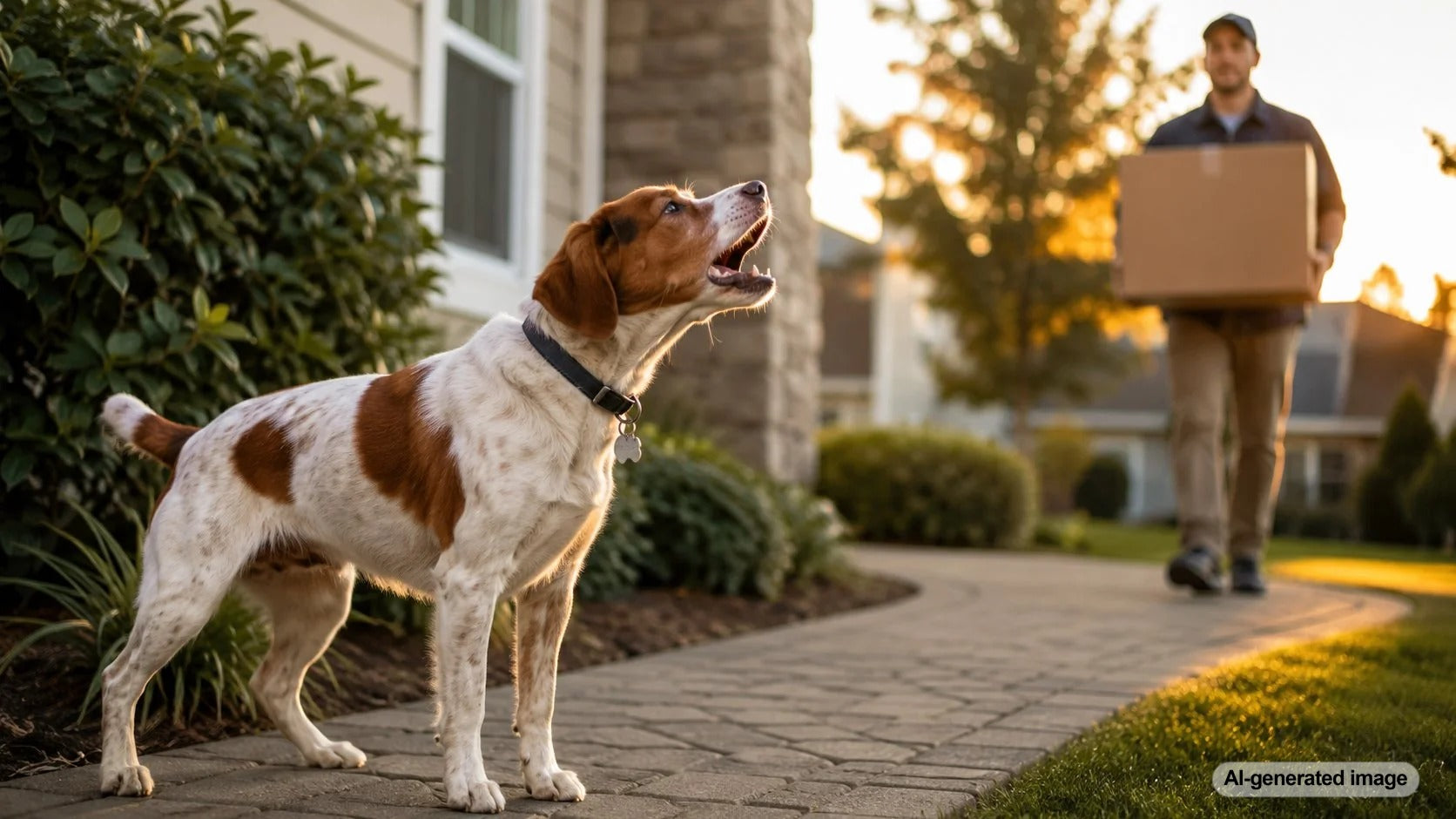
A person walking normally may barely earn a glance from your dog, but add a ladder, large box, umbrella, trash bag, or bulky delivery package and the barking suddenly begins. Your dog is not necessarily being stubborn or aggressive. The person's familiar human shape has changed, and the object's size, movement, sound, or unusual outline may make the situation feel suspicious.
The most helpful response is to create distance, keep your dog below the point where barking takes over, and pair the sight of the unusual person with something rewarding. With patient practice, many dogs can learn that people carrying awkward objects are ordinary parts of the neighborhood rather than emergencies.
Why Large Objects Can Make People Look Scary
Dogs recognize people partly through their outline, posture, movement, scent, and facial visibility. A person carrying a mattress, rolling suitcase, folded stroller, stack of boxes, or landscaping tool may no longer match the picture of a person your dog expects.
The object can also move unpredictably. Cardboard flaps may bounce, trash bags may rustle, and ladders may extend far above a person's head. Some objects hide the person's face or cause them to walk with a stiff, uneven stride. To a cautious dog, that unusual combination can look more like one large moving creature than a person holding an item.
Barking may come from fear, surprise, territorial concern, excitement, or frustration. Pay attention to the rest of your dog's body. Leaning backward, tucked ears, a low tail, lip licking, or an attempt to retreat often suggests worry. Pulling forward with a stiff body, hard stare, growling, or lunging requires more careful management and professional guidance.
What to Do During an Unexpected Encounter
Your first job is not to demand perfect obedience. It is to prevent the situation from becoming so intense that your dog cannot think or respond.
- Create space: Cross the street, turn into a driveway, step behind a parked car, or make a calm U-turn.
- Keep the leash secure but relaxed: Avoid pulling your dog directly toward the trigger or holding the leash continuously tight.
- Feed when your dog notices: Offer a rapid sequence of small treats while the person and object are visible.
- Leave before barking escalates: Distance is useful training information, not a failure.
If your dog is too upset to eat a favorite treat, respond to their name, or briefly look away, you are probably too close. Move farther away rather than repeating commands more loudly.
For convenient rewards on walks, small treats such as Love Nuggets can be broken or delivered quickly when your dog spots an unusual object. The goal is not to distract your dog after a full reaction. It is to help the strange sight predict something positive while your dog is still able to learn.
Practice With Controlled, Easy Setups
Training is easier when you control the object's distance, movement, and difficulty. Ask a familiar helper to stand far away while holding a small, ordinary object such as a folded tote bag. Let your dog look, then immediately offer a treat. When the object disappears behind the helper's back, the treats stop.
Gradually change only one detail at a time. The helper might hold the bag at their side, lift it slightly, walk slowly, or switch to a larger object. Your dog should remain loose enough to eat and disengage. If barking begins, return to an easier version by increasing distance, reducing movement, or using a smaller object.
Short sessions are best. Two calm minutes can be more valuable than fifteen minutes that end with your dog overwhelmed. Practice with different objects over multiple days so your dog learns a broader lesson rather than becoming comfortable with only one box or umbrella.
Teach a Simple Alternative Behavior
A familiar action gives your dog something predictable to do when an unusual sight appears. Useful options include looking at you, touching your hand with their nose, walking beside you for several steps, or searching the ground for scattered treats.
Practice the behavior at home and on quiet walks before using it around a trigger. Once it is fluent, cue it while your dog is still calm. Do not wait until your dog is barking, lunging, and unable to process the request.
After a difficult walk, quiet enrichment can help your dog settle back into a familiar routine. A food-filled The Pupsicle may provide a calm, engaging activity at home, but it should complement training rather than replace careful exposure and behavior support.
Common Mistakes That Can Make Barking Worse
Scolding, leash corrections, or forcing your dog to approach the object may increase the negative association. Your dog could begin to think that strange-looking people predict discomfort from both the environment and their owner.
It is also easy to move too quickly. A dog who succeeds with a stationary umbrella across the street may not be ready for a person opening that umbrella five feet away. Progress is rarely perfectly linear, so lower the difficulty whenever your dog shows increasing stress.
Avoid asking strangers to reach toward, stare at, or hand-feed a frightened dog. The dog should be allowed to observe from a comfortable distance without social pressure.
When to Get Professional Help
Contact a qualified positive reinforcement trainer or veterinary behavior professional if your dog regularly lunges, snaps, redirects onto the leash, cannot recover after the trigger passes, or is becoming reactive to more people and objects. A sudden major behavior change can also be associated with pain, changes in vision or hearing, or another health concern, so ask your veterinarian when the behavior appears unexpectedly.
Use barriers, distance, secure walking equipment, and quieter routes while you seek help. Management protects everyone and prevents repeated practice of an intense reaction.
Dog Parent FAQs
Should I let my dog investigate the large object?
Only when your dog is relaxed, the person agrees, and the object can be placed safely on the ground. Never force an approach. Your dog should be free to move away.
Why does my dog bark at delivery workers carrying boxes?
The combination of a stranger, a hidden body outline, a bulky moving object, and an approach toward the home can trigger surprise or territorial concern.
Should I pick up my small dog when they start barking?
Picking up a small dog may be appropriate for immediate safety, but move away calmly rather than carrying the dog closer to the trigger. Continue gradual training at a comfortable distance.
How long will this training take?
It varies by dog, trigger history, and reaction intensity. Some dogs improve after several well-managed sessions, while fearful or highly reactive dogs may need a longer, carefully paced plan.
Build Confidence One Calm Sighting at a Time
Your dog does not need to love ladders, rolling suitcases, or people hidden behind giant packages. The practical goal is for your dog to notice the unusual sight, remain within a manageable emotional range, and look to you for guidance.
Use distance generously, reward calm observation, and keep practice sessions easier than you think they need to be. Repeated safe experiences can gradually turn a startling neighborhood sight into something your dog knows how to handle.


