






































































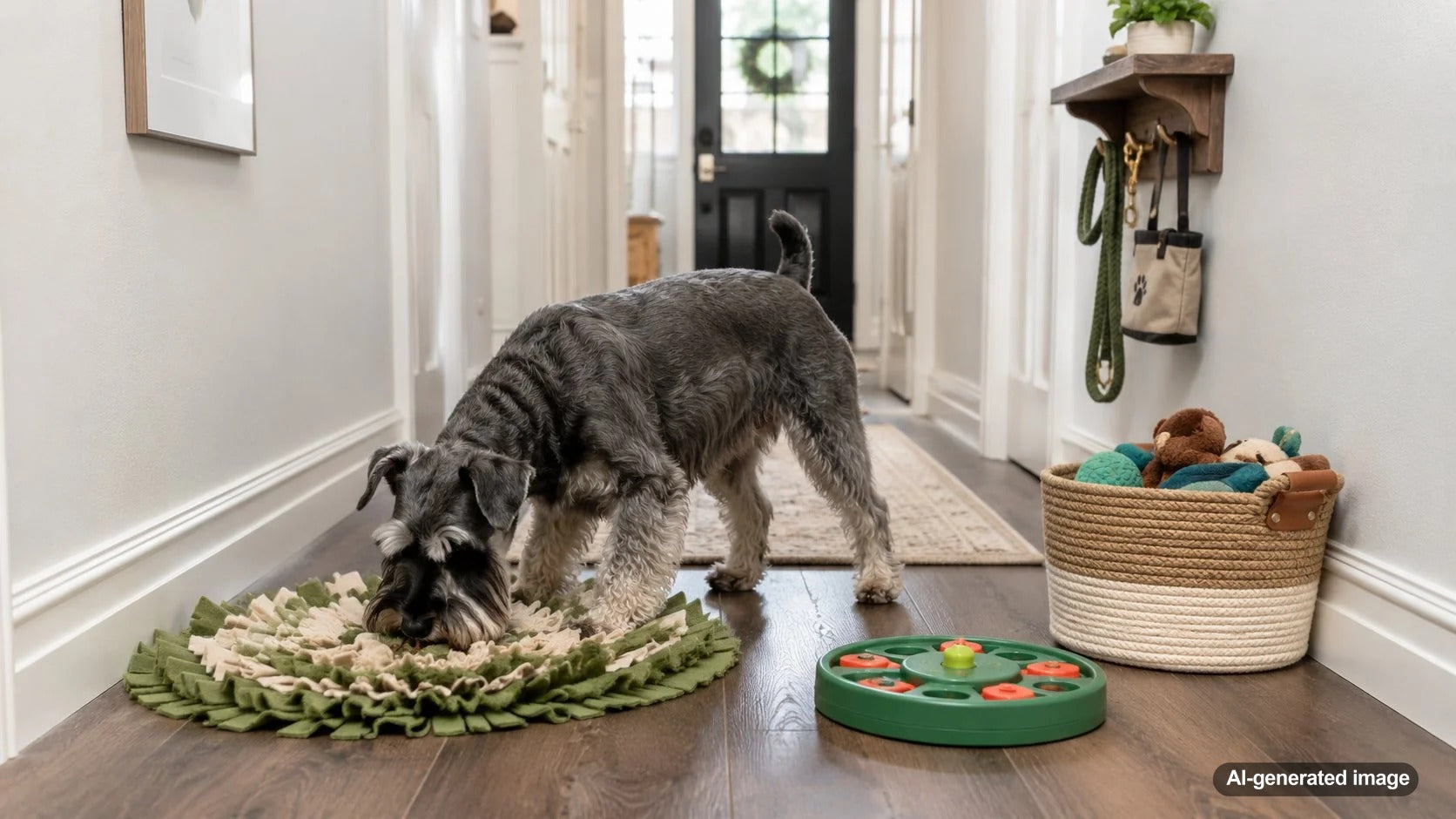
That narrow stretch between your rooms may look like wasted space, but your dog may see the beginnings of an excellent indoor playground. You can turn a hallway into a dog enrichment zone by using its length for scent searches, simple training drills, food puzzles, and controlled movement games. With a clear floor, a few dog-safe supplies, and short supervised sessions, even a small hallway can provide meaningful mental and physical activity.
A hallway enrichment zone is especially useful during rainy weather, busy workdays, extreme temperatures, or any time a full outdoor adventure is not practical. It should complement walks and outdoor exploration rather than replace them, but it can make an ordinary day much more interesting.
Quick answer: Clear the hallway of hazards, add a nonslip surface if needed, and rotate between sniffing games, puzzle toys, slow-feeding activities, training stations, and low-impact obstacle work. Keep each activity appropriate for your dog's age, size, mobility, and chewing style.
Start With a Safe, Clutter-Free Hallway
Before adding games, look at the hallway from your dog's level. Remove shoes, electrical cords, unstable decorations, sharp-edged objects, and anything that could be swallowed. Secure doors so they cannot swing into your dog, and keep stairs blocked if your hallway ends near a staircase.
Slippery flooring is one of the most common problems. A dog accelerating after a rolling toy can lose traction on hardwood or tile, particularly if the dog is a puppy, senior, large breed, or dealing with mobility limitations. Use a secured runner or nonslip mats, and avoid games that encourage hard stops or sharp turns.
The hallway should remain a shared passageway, not a permanent obstacle course. Choose activities that can be set up and removed in a few minutes.
Create a Sniffing Trail
Scent games are ideal for narrow spaces because they do not require your dog to sprint. Start by placing a few pieces of kibble or small treats in plain sight along the edges of the hallway. Give a cue such as "find it," then let your dog investigate at a comfortable pace.
Once your dog understands the game, hide rewards behind an open door, beside a stable box, under an overturned dog-safe cup, or inside a loosely folded towel. Change the hiding places so your dog relies on their nose instead of memorizing a pattern.
Keep the first searches easy. A dog that wanders away, barks at the setup, or begins biting containers may be frustrated rather than enriched. Reduce the difficulty and celebrate small successes.
Build a Puzzle Station at One End
Use one end of the hallway as a quiet problem-solving station. A treat-dispensing toy, slow feeder, or food puzzle can encourage licking, nudging, and focused exploration without filling the entire walkway.
The rolling Walkabout can turn a portion of your dog's meal into an indoor search-and-move activity. Adjust the opening to suit the size of the kibble, begin with an easy setting, and supervise until you know how your dog interacts with it.
For a calmer station, spread an appropriate portion of your dog's food on the FlipMat. Its two sides let you vary the challenge, making it useful for dogs who benefit from slower, more deliberate licking rather than fast-paced play.
Add Simple Training Stops
Place two or three removable markers along the hallway. These can be small mats, folded towels, or pieces of painter's tape that your dog will not chew. Each marker becomes a station for a simple behavior:
- Stop one: sit and make eye contact.
- Stop two: touch your hand with their nose.
- Stop three: lie down or settle on a mat.
- Finish: walk calmly back to the starting point.
This setup provides mental work while reinforcing useful household skills. Puppies may need only one or two stations. Experienced dogs can practice waiting, backing up a step, turning around, or carrying a toy from one end to the other.
Use tiny rewards so the session does not add too many calories. You can also reserve part of your dog's regular meal for training.
Make a Low-Impact Obstacle Lane
A hallway can support a miniature obstacle course, but it should focus on coordination rather than jumping. Ask your dog to step over a pool noodle placed flat on the floor, walk between two stable objects, pause on a mat, or weave around wide, soft markers.
Avoid stacking objects, creating tight jumps, or using furniture that could tip. Senior dogs and dogs with orthopedic concerns may do better with scent trails and stationary puzzles. Check with your veterinarian before introducing new physical challenges if your dog has pain, limping, weakness, or a history of joint or back problems.
Use the Hallway for Controlled Fetch
Some small dogs enjoy short hallway fetch sessions because the walls help keep the toy moving in one direction. Use a soft toy that cannot damage walls or flooring, and roll it instead of throwing it high. Ask for a pause between repetitions to prevent the game from becoming frantic.
Hallway fetch is not the best choice for every dog. Large dogs may not have enough room to turn safely, while power chewers may destroy soft toys quickly. Stop if your dog begins sliding, crashing into walls, guarding the toy, or becoming too excited to respond to familiar cues.
Helpful tip: Rotate the activity instead of adding more equipment. Monday might be a scent trail, Tuesday a puzzle station, and Wednesday a three-stop training course. Novelty often comes from changing the challenge, not buying more things.
Keep Sessions Short and Repeatable
A useful enrichment routine does not need to occupy an entire afternoon. Many dogs do well with five to fifteen minutes, depending on the activity and their individual interest. End while your dog is still successful, then clear away food, toys, cups, towels, and obstacles.
Watch how your dog responds afterward. A good session may leave them pleasantly satisfied and ready to rest. Persistent panting, frantic searching, barking, destructive behavior, or an inability to settle can mean the activity was too intense or frustrating.
Always supervise chewing and food-based enrichment. Choose toys and treats that match your dog's size and chewing habits, and remove anything that becomes damaged or small enough to swallow. Contact your veterinarian if your dog swallows part of a toy or chew, or develops vomiting, excessive drooling, appetite changes, abdominal discomfort, or unusual behavior.
Common Hallway Enrichment Mistakes
Avoid these setup problems: placing games on slick floors, blocking essential walkways, making puzzles too difficult too quickly, leaving food activities unattended, using tiny household objects as obstacles, and encouraging repeated high-speed turns in a confined space.
The goal is not to exhaust your dog. It is to give them safe opportunities to sniff, think, lick, move, and practice useful behaviors. A simple setup your dog enjoys several times a week is more valuable than an elaborate course that causes confusion.
Dog Parent FAQs
Can a hallway enrichment zone replace a walk?
No. Hallway games can support mental stimulation and indoor activity, but most dogs still benefit from appropriate outdoor exercise, fresh air, sniffing opportunities, and environmental variety.
How often should I change the hallway activities?
Rotate activities whenever your dog begins completing them automatically or losing interest. Changing one element, such as the hiding places or training order, may be enough.
Are hallway games safe for senior dogs?
They can be when the floor has good traction and the activities are slow and low impact. Choose sniffing, licking, and simple station work, and ask your veterinarian about limitations if your senior dog has mobility concerns.
What should I do if my dog gets frustrated?
Make the task easier, use more visible rewards, and shorten the session. If frustration regularly escalates into barking, biting, guarding, or distress, consult a qualified trainer or veterinary behavior professional.
A Small Space With Plenty of Possibilities
Learning how to turn a hallway into a dog enrichment zone is mostly about using space thoughtfully. Begin with safety, introduce one easy activity, and pay attention to what your dog genuinely enjoys. With a little rotation, the most ordinary corridor in your home can become a sniffing trail, puzzle area, training lane, or calming station that helps make indoor days more satisfying.


